Sleepy Cat: A Handwritten Font That Feels Like Home
It started with a candle—just one, sitting on my workbench beside a half-printed label. I’d been testing fonts all morning for our new lavender-vanilla line, and nothing quite landed. Some felt too stiff, others too fussy. Then I opened Sleepy Cat. Instantly, the lowercase “l” curled like steam rising off a warm mug. The “a” had that gentle, slightly uneven tilt—like handwriting you’d find in a well-loved recipe journal. My shoulders relaxed. This wasn’t just another script font. This was the one.
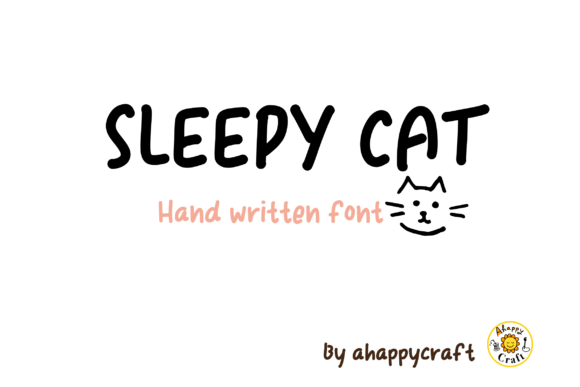
Sleepy Cat is a sweet, friendly handwritten font from Script Amp—a premium font collection made for makers who care about warmth, authenticity, and quiet intention. It’s not overly ornate or theatrical. Instead, it balances natural flow with subtle personality: soft entry strokes, gentle exits, and a rhythm that feels human—not algorithmic. There’s a calm confidence in its curves, a gentle pause between letters, like breath held before a smile. It doesn’t shout. It invites.
I first used Sleepy Cat on kraft paper candle labels—printed on my home inkjet, then cut with my Cricut Maker. The font scaled beautifully down to 14pt for ingredient lists (using the clean, minimal alternate characters), and bloomed luxuriously at 48pt for the scent name “Honey & Thyme.” No jagged edges, no broken joins—even at small sizes, the letterforms stayed legible and graceful. For sticker sheets, I paired Sleepy Cat with a light-weight sans serif (like Montserrat Light) for descriptions and pricing—letting the script carry emotion while the sans kept things clear and scannable.
It shines brightest where handmade charm matters most: greeting cards with hand-torn edges, wedding welcome boards leaning against a farmhouse door, printable wall art for nurseries and cozy reading nooks. I designed a set of planner page dividers last spring—“Rest,” “Create,” “Breathe”—all in Sleepy Cat, each word spaced generously, echoing the slow, intentional pace those words suggest. Customers told me they *felt* calmer flipping through the pages. That’s not accidental—it’s typography doing quiet, meaningful work.
For digital downloads, Sleepy Cat adds instant character to editable Canva templates, PDF planners, and SVG cut files. When previewing a printable tea-themed gift tag in my shop listing, I used Sleepy Cat for the phrase “Steep Slowly” and paired it with a simple serif (Lora Regular) for the fine print. The contrast gave hierarchy without tension—elegant but never pretentious.
What makes Sleepy Cat especially practical for product makers? Its thoughtful design supports real-world production. The file includes OpenType features—ligatures, stylistic alternates, and swashes—so you can soften a title with a flowing “&” or add a delicate terminal swash to a final “y” on a boutique tote bag design. It comes in both OTF and TTF formats, works smoothly in Silhouette Studio and Cricut Design Space, and renders cleanly on screen and in print. I tested it on matte-finish vinyl stickers (3” round), cotton twill tags (heat-pressed), and ceramic mugs (sublimation printed)—and every time, the ink sat true, the curves held shape, and the mood stayed consistent.
Readability is where many handwritten fonts falter—but Sleepy Cat keeps clarity front of mind. It’s best suited for short phrases, names, titles, and decorative headings—not long paragraphs. Think: “Hand-poured in Small Batches” on a soap label, not the full ingredients list. For longer text, pair it intentionally: use Sleepy Cat for the headline (“You Are Enough”), then switch to a clean sans serif (like Poppins) or soft serif (Cormorant Garamond) for body copy. That pairing creates visual breathing room and reinforces brand voice—warm but grounded, creative but trustworthy.
I’ve used Sleepy Cat across seasons—soft peach holiday tags stamped with gold foil, chalkboard-style spring market signs, minimalist black-and-white wedding suite envelopes. Each time, it adapts without losing its core identity. It doesn’t compete with your product; it complements it. A linen tea towel feels more considered with Sleepy Cat stitched subtly into the corner. A ceramic mug feels more like a ritual object when “Sip Mindfully” flows across its curve.
Before using Sleepy Cat commercially—on physical goods, digital templates, or SVG bundles—I double-checked its licensing terms. Script Amp fonts include full commercial use rights, which means you’re covered for resale on Etsy, Shopify, or craft fairs—as long as you’re embedding or converting properly (no reselling the font file itself). I also confirmed multilingual support covers basic Latin characters and common diacritics—enough for English, French, Spanish, and German shop listings and product copy.
What I love most isn’t just how Sleepy Cat looks—but how it *works*. It fits into my process like a familiar tool: intuitive in layout software, reliable in cutting machines, expressive in mockups, and deeply resonant on finished pieces. It doesn’t ask you to over-design around it. It simply shows up—gentle, sincere, and quietly unforgettable.
If you’re choosing a script font to represent your handmade voice—to signal care in a candle label, tenderness in a baby announcement, or ease in a self-care printable—you’re not just picking type. You’re choosing tone, texture, and trust. Sleepy Cat doesn’t try to be everything. It’s just perfectly, peacefully itself—and that’s exactly what makes it so useful.